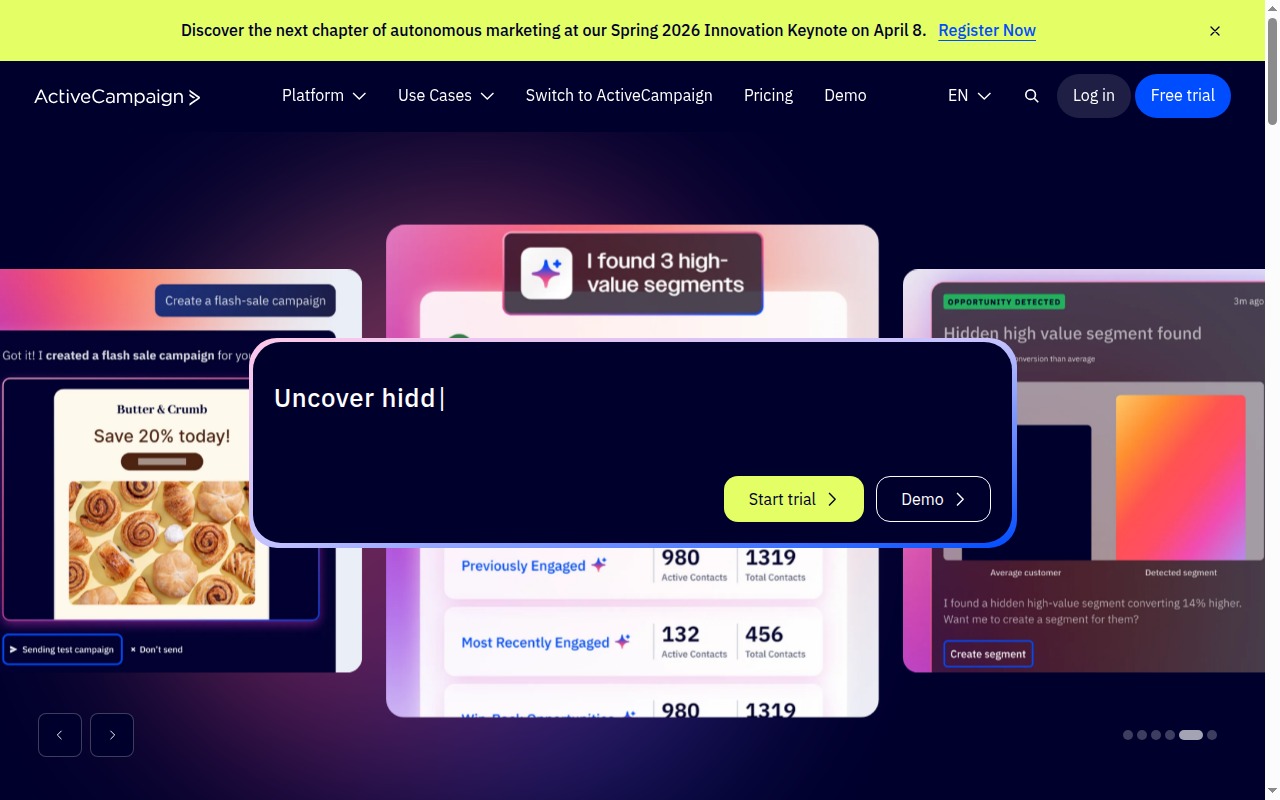
ActiveCampaign is the tool you graduate to when you’ve outgrown “send a newsletter every Tuesday.” It’s the email marketing platform where real marketing automation lives — conditional logic, behavior-triggered sequences, lead scoring, CRM pipeline, site tracking that fires automations based on what pages someone visits. This is not a tool you buy because it’s cheap or because the onboarding is frictionless. You buy it because your business actually depends on lifecycle marketing, and you need it done properly.
The question is whether you’re at that stage yet. Because if you’re not, you’re paying for infrastructure you won’t use — and ActiveCampaign is not cheap.
What Is ActiveCampaign?
ActiveCampaign is an email marketing, marketing automation, and CRM platform that occupies the mid-market space between simple tools like MailerLite and enterprise platforms like HubSpot or Marketo. It’s used by e-commerce businesses, SaaS companies, coaches, and marketing agencies who need sophisticated automation workflows and integrated sales pipeline management.
The platform has been around since 2003 — it predates the AI writing tools and no-code builders that dominate today’s SaaS conversation — and it shows in the depth of the product. ActiveCampaign’s automation engine is not a recent addition designed to match a competitor. It’s the core of the platform, built over two decades.
ActiveCampaign Pricing
| Plan | Monthly Price (1k contacts) | What You Get |
|---|---|---|
| Starter | $29/mo | Basic automation, email marketing, forms, reporting |
| Plus | $49/mo | CRM + deal pipelines, landing pages, lead scoring, Facebook Custom Audiences |
| Professional | $149/mo | Predictive sending, attribution reporting, site messaging, split automations |
| Enterprise | $259/mo | Custom objects, SSO, dedicated account rep, custom reporting |
All prices are for 1,000 contacts. Pricing scales with list size — at 5,000 contacts, Starter is $79/month, Plus is $125/month. At 10,000 contacts, Starter is $139/month, Plus is $174/month.
Compare this to MailerLite’s Growing Business plan at $9/month for 1,000 contacts. That’s a $20/month gap at entry-level, which becomes a much wider gap as you add contacts. You need to be confident you’re using what ActiveCampaign offers.
Key Features
Visual Automation Builder
This is ActiveCampaign’s signature feature and its strongest argument for the price. The visual automation builder lets you construct complex, conditional email sequences with a drag-and-drop workflow editor. Triggers, conditions, wait steps, branching logic, goal steps, split tests within automations — it’s all here.
The sophistication matters in practice. You can build an automation that: sends a welcome email → waits 3 days → checks whether the subscriber opened → if yes, sends the next email; if no, sends a re-engagement email → waits 5 more days → checks whether they clicked any link in either email → if yes, adds to “engaged” segment; if no, removes from active list and adds to a reactivation sequence.
This kind of conditional lifecycle logic is what email marketing automation is actually for. Most cheaper tools support the idea of it but not the execution depth.
CRM with Deal Pipelines
ActiveCampaign includes a full CRM — contact profiles, deal stages, task management, sales pipeline tracking. This is available from the Plus plan upward. The integration with email automation is what distinguishes it: a contact’s behavior in your email sequences can automatically move deals through the pipeline, trigger tasks for your sales team, or update contact fields. Marketing and sales workflows stay synchronized without manual intervention.
For small SaaS companies, coaches with sales calls, or agencies managing client relationships, this integration is genuinely valuable. You don’t need a separate CRM — ActiveCampaign handles it.
Lead Scoring
Assign point values to contact behaviors — opens, clicks, page visits, purchases, form fills. Set threshold scores that trigger automations: when a lead hits 50 points, notify your sales team; when they hit 100, move them to a high-intent sequence. Available from Plus plan upward.
Lead scoring is a mature feature in ActiveCampaign. The configuration is flexible, the triggers are reliable, and the behavioral data is rich enough to build meaningful scoring models.
Predictive Sending
Available on Professional plans. ActiveCampaign analyzes each subscriber’s historical open behavior and schedules emails to arrive at the specific time each individual is most likely to open them. Not a “send to time zone” feature — actual per-subscriber optimization based on behavioral data.
Does it meaningfully improve open rates? In practice, the gains are incremental for most businesses. It’s a nice feature at the Professional tier, but it shouldn’t be the reason you’re upgrading.
Site Tracking
ActiveCampaign can track which pages on your website a subscriber visits, and use that data to trigger automations. Visited the pricing page twice in a week? Trigger a sales follow-up sequence. Downloaded a specific resource? Move them to the corresponding nurture track.
Site tracking closes the loop between web behavior and email automation. For businesses with meaningful website traffic and segmented audiences, this is a powerful capability. It requires installing a tracking script on your site.
Conditional Content in Emails
Show different content blocks to different subscribers within the same email based on tags, fields, or list membership. One email send, personalized content per recipient. This is particularly useful for mixed audiences where you have distinct segments with different interests but want to manage a single send operation.
What ActiveCampaign Does Well
Automation depth that’s actually usable. The visual builder is sophisticated but not impenetrable. You can build multi-step conditional automation sequences without a developer or a consultant, which is not something that can be said for most tools with equivalent capability.
CRM integration that actually works. Many tools claim email + CRM integration. In practice, they’re two separate products that share a database. ActiveCampaign’s automation-to-CRM connection is genuinely native — behaviors in email workflows update CRM records, move deals through pipelines, and trigger sales tasks without Zapier in the middle.
Deliverability is consistently strong. In third-party deliverability benchmarks, ActiveCampaign consistently lands in the upper tier. For a platform where automation-driven emails are time-sensitive and behavior-contingent, deliverability isn’t optional.
Reporting gives you actionable data. Beyond open and click rates, ActiveCampaign shows you automation performance, sequence completion rates, revenue attribution (Plus+), and the path contacts take through complex workflows. When something isn’t working, the reporting usually tells you where.
Where ActiveCampaign Falls Short
Expensive for small lists. $29/month for 1,000 contacts is hard to justify if you’re just sending a weekly newsletter and one welcome sequence. MailerLite handles that for $9/month. The price makes sense when you’re running complex lifecycle automations that generate measurable revenue. If you’re not at that stage, you’re overpaying.
Learning curve is real. New users regularly report being overwhelmed. The feature set is deep, and the interface surfaces a lot of it at once. Onboarding takes meaningful time. For a solopreneur or small business owner who just wants to get a nurture sequence running, the first week with ActiveCampaign is not friction-free.
Email template builder is dated. The drag-and-drop email editor works, but it looks and feels older than competitors. Templates are functional but uninspiring. Compared to the polished builder in MailerLite or the modern feel of Kit, ActiveCampaign’s email design experience is a step behind.
Support quality varies. Live chat support is available on all plans, but response times and resolution quality can be inconsistent. Complex automation questions sometimes require multiple escalations. For a platform you’re depending on for lifecycle revenue, inconsistent support is a genuine risk.
ActiveCampaign vs MailerLite
Apples and oranges, mostly. MailerLite is for businesses that need clean, capable email marketing at a low price. ActiveCampaign is for businesses where email automation is a core revenue driver and they need the depth to match.
If your automation needs are: welcome email, newsletter, occasional promotional campaign — use MailerLite. If your automation needs are: behavioral triggers, conditional branching, lead scoring, site tracking, CRM pipeline — use ActiveCampaign. There’s no overlap where they’re genuinely competing for the same buyer.
ActiveCampaign vs GetResponse
GetResponse competes more directly. Both tools offer email marketing, CRM, and automation. GetResponse adds webinars and a more polished funnel builder; ActiveCampaign adds automation depth and more sophisticated lead scoring.
If webinars are central to your business model and you want an integrated solution, GetResponse is worth considering. If you’re optimizing for lifecycle marketing complexity and CRM integration, ActiveCampaign wins. The choice is often that specific.
Who Should Use ActiveCampaign?
- E-commerce businesses using behavior-triggered automation — cart abandonment, post-purchase sequences, product recommendations
- SaaS companies with trial-to-paid nurture sequences and usage-based triggers
- Coaches and consultants with high-touch sales processes and a need for CRM + email in one place
- Marketing agencies managing client lifecycle automation across multiple accounts
- Any business where email automation is generating measurable revenue and the cost of getting it wrong is real
Skip ActiveCampaign if:
- You’re just starting your email list and sending a weekly newsletter — start with MailerLite
- You have under 2,000 contacts and don’t need CRM — the $29/month Starter plan doesn’t justify itself at that scale
- You want simple, fast onboarding — ActiveCampaign will slow you down
- Webinars are your primary lead generation channel — GetResponse is more purpose-built for that
Final Verdict
ActiveCampaign is the right tool for the right business. The automation builder is the best in its class among mid-market platforms. The CRM integration is native and powerful. Deliverability is reliable. When your email automation is generating real revenue, the price is easy to justify.
When your email marketing is still in the “weekly newsletter + one welcome sequence” stage, it’s expensive infrastructure you’re not using. Start cheaper, graduate when the complexity demands it.
Rating: 4.3/5
Best for: Businesses where email automation is a core revenue mechanism and requires genuine lifecycle marketing depth.
Try ActiveCampaign → ActiveCampaign
Compare all email marketing options → Best Email Marketing Software 2026