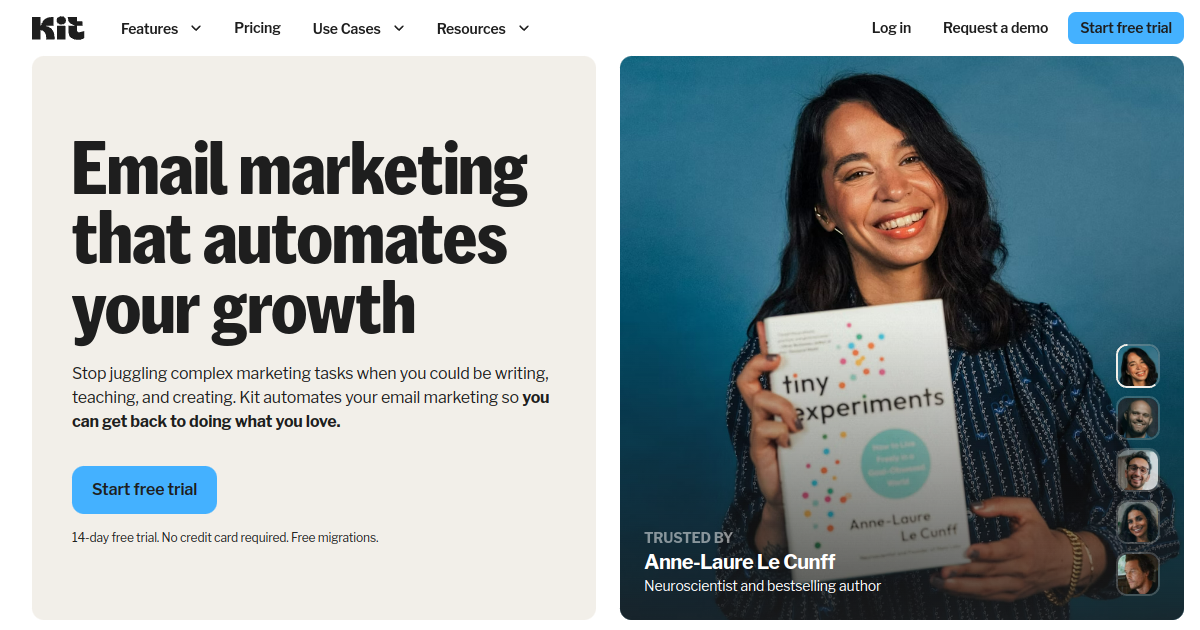
Kit — formerly ConvertKit — built its reputation by doing one thing well: helping independent creators grow and monetize their email lists. For years it was the default recommendation for bloggers, course creators, and newsletter writers who needed more than a basic email tool.
The question in 2026 is whether it’s still worth the premium. Cheaper alternatives have gotten better. Kit has evolved, rebranded, and added features. The gap has narrowed in both directions.
Here’s the honest take.
What Is Kit (Formerly ConvertKit)?
Kit is an email marketing platform designed specifically for online creators — bloggers, YouTubers, podcasters, course sellers, newsletter writers, and anyone building an audience-based business.
Founded in 2013 by Nathan Barry, it rebranded from ConvertKit to Kit in 2024. The rebrand reflects a broader vision: Kit wants to be the operating system for creator businesses, not just the email tool. That ambition shows in the product direction — features like paid newsletters, the Creator Network (a recommendation platform), and digital product sales are built in.
The core product is still email. But the framing is different from tools like MailerLite or Mailchimp: Kit is built around the idea that your subscribers are your customers, not just contacts.
Kit Pricing: Free, Creator, Creator Pro
Free Plan
Kit’s free plan is genuinely generous: up to 10,000 subscribers with unlimited email sends. That’s one of the best free tiers in the market by subscriber count.
What you don’t get on free: automations, sequences, or integrations. The free plan is essentially a broadcast-only newsletter tool. You can send campaigns to your list, but you can’t automate anything — no welcome sequences, no drip campaigns, nothing conditional. For building automation logic, you need to upgrade.
Creator Plan
Starts at $25/month for up to 1,000 subscribers (billed monthly). Includes:
- Unlimited automations and sequences
- Visual automation builder
- All integrations (Shopify, Teachable, Stripe, etc.)
- Landing pages and forms
- Third-party integrations via Zapier/Make
- Newsletter referral system
At 5,000 subscribers: ~$66/month. At 10,000: ~$100/month.
Creator Pro Plan
Starts at $50/month for up to 1,000 subscribers. Adds:
- Subscriber scoring
- Advanced reporting
- Newsletter referral system (unlimited)
- Facebook custom audiences integration
- Priority support
Most users don’t need Creator Pro until they’re running a serious monetized list and want subscriber scoring or advanced reporting.
On annual billing: roughly 17% discount across all plans.
Start Kit free (up to 10,000 subscribers) → Kit
Core Features: Email Sequences, Automations, Landing Pages
Visual Automation Builder
This is Kit’s strongest technical differentiator. The automation canvas lets you build branching logic visually: if a subscriber clicks link A, send them sequence X; if they don’t open in 3 days, send a follow-up; if they purchase, remove them from the nurture flow.
The builder is intuitive once you understand the logic. It uses events (triggers), conditions (if/then), and actions (send email, add tag, move to sequence). You can build fairly complex flows without hitting a wall — much more so than MailerLite.
Sequences (Drip Campaigns)
Sequences are pre-written email series delivered over time — your welcome sequence, your email course, your onboarding flow. Kit’s sequence editor is clean and well-designed. You set delays in days, choose send times, and can branch based on engagement.
Tagging and Segmentation
Kit is built around tags rather than lists. A subscriber can have multiple tags, and automations can add/remove tags based on behavior. This is more flexible than list-based systems — you’re not moving people between lists, you’re layering context onto a single subscriber record.
The subscriber profile view is clean: you can see every tag, sequence, purchase, and email interaction for a single person. For creator businesses where individual subscriber relationships matter, this is genuinely useful.
Landing Pages and Forms
Kit includes a landing page builder with a template library that’s well-designed for creator use cases: lead magnet opt-ins, newsletter landing pages, course waitlists. The templates aren’t the most customizable, but they convert well and look professional out of the box.
Forms — embedded opt-in forms for your website — are clean and easy to set up. The spam filtering is solid.
Creator Network
Kit’s Creator Network is a built-in recommendation platform: after someone subscribes to your newsletter, Kit shows them recommendations for other newsletters to follow. If someone subscribes to a newsletter that recommends yours, and they subscribe, Kit counts them as an “organic” referral within the network.
This is a real growth channel for newsletters in a crowded space. It’s unique to Kit — no competitor has an equivalent at this scale. For newsletter operators specifically, it’s a meaningful differentiator.
Paid Newsletters and Digital Products
Kit lets you charge for newsletter subscriptions directly — monthly or annual billing, powered by Stripe. You keep the subscriber relationship; Kit handles the payment infrastructure.
Digital product sales (e-books, templates, courses) are also built in. This tightens the creator monetization loop: grow your list, sell directly to it, track who bought what, and automate follow-up — all in one tool.
What Kit Does Really Well
The automation builder is genuinely powerful. It’s visual, flexible, and doesn’t hit walls at moderate complexity. For creators who want to build real audience funnels — not just blast newsletters — it’s the right tool.
Tagging is the right data model for creators. List-based systems create friction when a subscriber is in multiple segments. Tag-based systems are more elegant and more accurate.
The Creator Network is a real moat. No other tool in this space has a built-in recommendation network at Kit’s scale. If newsletter growth is a priority, this is a genuine advantage.
Monetization is native. Paid newsletters and digital product sales being built in means fewer tools, fewer integrations to maintain, and cleaner data. For creator businesses, this matters.
Clean, well-designed interface. Kit’s UI is among the best in the category. It doesn’t feel like enterprise software. It feels like it was built by people who use it.
Kit’s Limitations and Frustrations
Price. Kit is expensive relative to its competitors. At 5,000 subscribers, you’re paying $66/month for Creator vs $19/month for MailerLite. That $47/month gap compounds over a year to $564 — real money for an early-stage creator business. The premium is justified if you use the automation and monetization features. It’s not justified if you’re just sending newsletters.
Free plan is misleading. 10,000 subscribers sounds incredible. But without automations, it’s a hobbled product. You can’t run a welcome sequence, you can’t segment based on behavior, you can’t do anything conditional. The free plan is a lead-generation tool for Kit, not a genuinely usable product.
Landing page customization is limited. The templates are good-looking but not highly flexible. If you want granular design control, you’ll need to use your own landing page tool or a custom coded page.
Deliverability is good but not exceptional. Kit’s deliverability is solid, but some users have reported inbox placement issues with certain ISPs. It’s not a dealbreaker, but it’s worth monitoring when you switch.
No built-in heatmaps or deep analytics. Like most email tools, Kit’s reporting shows open rates, click rates, and unsubscribes. Revenue attribution exists at the basic level. For deeper analytics, you’re adding third-party tools.
The rebrand from ConvertKit to Kit created some confusion. Affiliate links changed, documentation was in transition, and some integrations had temporary hiccups. Most of this is resolved in 2026, but it’s worth knowing the platform went through a period of turbulence.
Kit vs MailerLite vs ActiveCampaign
Kit vs MailerLite
Full MailerLite vs Kit comparison
The core tradeoff: Kit is more powerful and more expensive; MailerLite is more affordable and easier to start with.
Choose Kit over MailerLite if:
- You’re building a creator business around your list (paid newsletters, digital products)
- You want access to the Creator Network for newsletter growth
- Your automation logic will eventually get complex
- You can justify $25–$66+/month at your current stage
Choose MailerLite over Kit if:
- You’re early-stage and budget is real constraint
- You need a capable free plan with real automation (MailerLite’s free plan has automations; Kit’s doesn’t)
- Your email needs are primarily newsletters and simple sequences
See the MailerLite review for the detailed breakdown.
Kit vs ActiveCampaign
ActiveCampaign is the step up from Kit when you need CRM-level capability. It offers contact scoring, deal pipelines, site tracking, and automation logic that goes significantly deeper than Kit.
The tradeoff: ActiveCampaign is more complex, has a steeper learning curve, and costs more. For pure creator businesses without a sales pipeline, the additional complexity rarely earns its keep. For businesses that blend content marketing with a sales operation, ActiveCampaign may be the better long-term fit.
See the ActiveCampaign review for the full comparison.
Who Is Kit Best For?
Kit is the right choice if:
- You’re a content creator, blogger, podcaster, or newsletter writer building an audience
- You plan to sell digital products or paid newsletter subscriptions to your list
- You want access to the Creator Network for newsletter growth
- You need real automation power (welcome sequences, behavioral branching, tagging logic)
- You can justify the cost relative to what you’re building
Kit is not the right choice if:
- You’re just starting out and budget is tight (MailerLite or Moosend are better starting points)
- Your email needs are simple — mostly newsletters, no complex automation
- You need CRM-level contact management and deal pipelines (ActiveCampaign is better)
- You want a free plan with real automation included (MailerLite’s free tier beats Kit’s here)
Final Verdict
Kit earns its position as the leading email tool for creator businesses — but it’s not the right tool for everyone, and it’s definitely not the cheapest.
If you’re building a serious audience-based business — selling courses, running a paid newsletter, growing through recommendations — Kit’s combination of automation power, Creator Network, and native monetization makes it worth the premium. The tagging model is the right data structure for this kind of business, and the automation builder gives you the flexibility to build real audience funnels.
If you’re early-stage, budget-constrained, or primarily sending newsletters without complex automation, start with MailerLite. You can migrate to Kit when the business justifies the cost.
Rating: 4.3/5
Best for: Independent creators and newsletter operators building monetized audience businesses who need real automation power and access to the Creator Network.
Try Kit free → Kit
See how Kit compares to every major alternative → Best Email Marketing Software 2026