Rating: 3.8/5
Mailchimp is one of the most recognized names in email marketing — and for good reason. It helped popularize the “freemium” email tool model, and for years it was the default recommendation for anyone starting out. But in 2026, things are more complicated. Recent pricing hikes, a gutted free plan, and a growing list of specialized competitors have put Mailchimp in an awkward position: still capable, but no longer obviously the right choice.
This review covers everything you need to know: current pricing, what features you actually get, what real users are saying, and who Mailchimp is (and isn’t) right for in 2026.
What Is Mailchimp?
Mailchimp is an all-in-one email marketing and marketing automation platform owned by Intuit. Founded in 2001, it’s one of the oldest players in the space and still claims one of the largest user bases in the industry — with over 12 million active users worldwide.
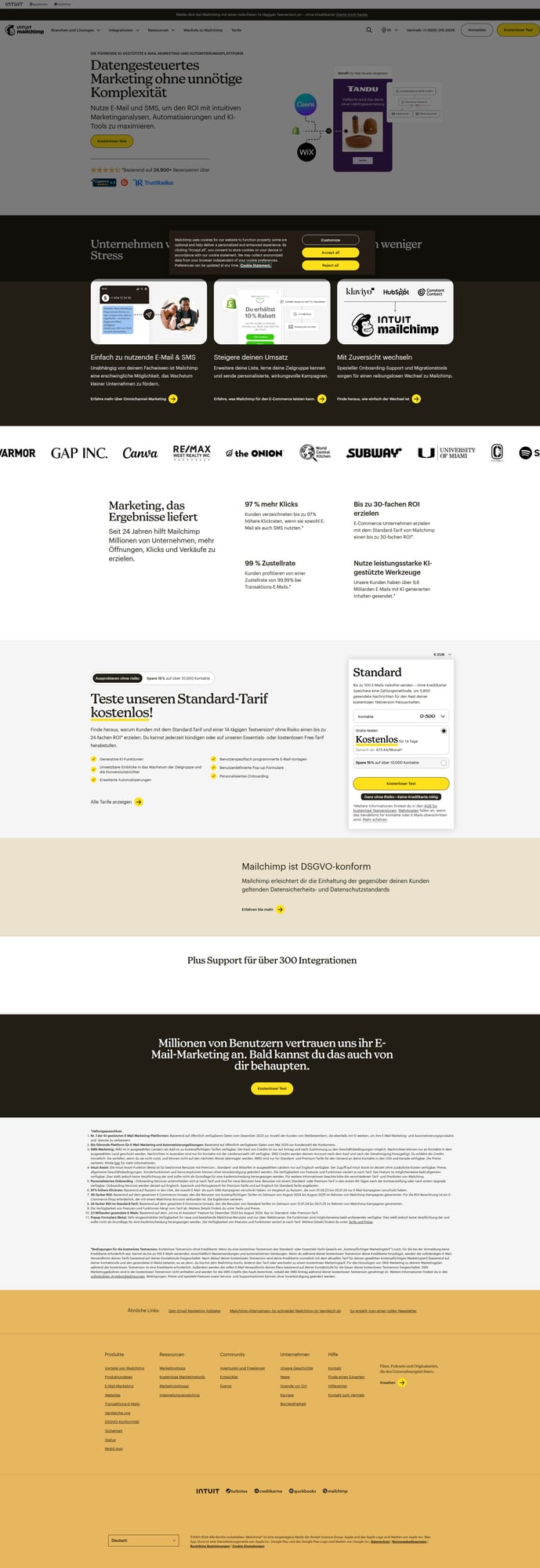
Originally built for small businesses and bootstrapped startups, Mailchimp has evolved into a broader marketing platform. Today it includes email campaigns, SMS marketing, landing pages, social ads, customer journey automation, e-commerce integrations, and AI-powered content tools — all under one roof.
In theory, it’s a one-stop shop. In practice, that breadth comes at a cost — literally and figuratively.
Mailchimp Pricing 2026
Mailchimp’s pricing has changed significantly — and not in a user-friendly direction. Here’s the current structure as of early 2026, with a price increase for legacy users taking effect in April 2026.
| Plan | Price (500 contacts) | Contacts Limit | Monthly Sends | Key Features |
|---|---|---|---|---|
| Free | $0/mo | 250 | 500/mo (250/day) | Basic templates, Mailchimp branding, 1 audience |
| Essentials | ~$13/mo | Up to 50,000 | 10x contact count | No branding, A/B testing, 3 audiences, chat/email support |
| Standard | ~$20/mo | Up to 100,000 | 12x contact count | Multi-step automation, dynamic content, predictive segmentation, 5 audiences |
| Premium | ~$350/mo (10k contacts) | 10,000+ | 150k+ | Unlimited audiences, multivariate testing, phone support, unlimited users |
Important note on the Free plan: As of January 2026, Mailchimp slashed the free plan from 500 contacts and 1,000 emails/month to just 250 contacts and 500 emails/month with a hard cap of 250 emails per day. For anyone seriously building a newsletter, this is effectively unusable.
Watch out for unsubscribed contacts: Mailchimp now bills for unsubscribed and duplicate contacts across audiences. If you don’t clean your lists regularly, your effective contact count — and bill — will be higher than you expect.
At 5,000 contacts, Essentials costs about $75/month and Standard about $100/month. For context, competitors like MailerLite offer comparable features at a fraction of the price at that list size.
Key Features
Email Builder
Mailchimp’s drag-and-drop email editor is genuinely good. It’s intuitive, well-organized, and comes with hundreds of mobile-responsive templates across categories (newsletters, promotions, announcements). For non-designers, it’s one of the faster paths to a professional-looking email.
Custom HTML is supported on Standard and above, which matters for brand-heavy teams. The AI Creative Assistant can generate branded templates and suggest image crops — useful, if not groundbreaking.
Automation & Customer Journeys
Mailchimp’s Customer Journey Builder lets you set up multi-step automated workflows triggered by subscriber behavior, purchase events, website activity, or lifecycle stages. Pre-built templates cover the most common sequences: welcome series, abandoned cart, post-purchase, and re-engagement.
There’s a critical catch: multi-step automation requires the Standard plan or higher. On Essentials, you only get single-step customer journeys. For anyone needing real automated sequences — the kind that actually drive revenue — this means Standard is effectively the minimum viable plan.
With the February 2026 updates, Mailchimp added 26% more e-commerce triggers and improved omnichannel automation that spans email and SMS. For e-commerce brands on Shopify or WooCommerce, this is genuinely useful.
Segmentation
Mailchimp’s segmentation is solid for a mid-market tool. You can segment by tags, groups, contact details, engagement history, location, purchase behavior (when connected to an e-commerce store), and more. AND/OR logic gives you reasonably granular control.
Predictive segmentation — which uses behavioral data to identify high-value customers, likely buyers, and at-risk contacts — is available on Standard and above. It’s a useful differentiator for e-commerce, but it requires your store to be connected and have enough data to be meaningful.
AI Features
Mailchimp has been adding AI tools aggressively. In 2026, the platform includes:
- Send Time Optimization: Predicts the best send time for each subscriber based on historical engagement.
- AI Creative Assistant: Generates on-brand email templates and suggests creative improvements.
- ChatGPT integration: Assists in writing email copy, subject lines, and campaign briefs.
- Predictive segmentation: Uses data to forecast customer behavior and identify high-value segments.
These are real features, not vaporware — but they’re bundled into an already-expensive platform rather than being a compelling standalone reason to choose Mailchimp over a cheaper alternative.
Integrations
Mailchimp connects with 300+ third-party tools including Shopify, WooCommerce, WordPress, Salesforce, Zapier, Google Analytics, Facebook Ads, and hundreds more. It’s one of the most-integrated email platforms in the market, which matters if you’re already in a complex tech stack.
Landing Pages & Forms
Mailchimp includes a landing page builder and embedded forms. They’re functional and template-driven, but not particularly flexible for teams that need custom designs. For basic lead capture, they work. For building a serious inbound funnel, you’ll likely want a dedicated tool.
Reporting & Analytics
Campaign reporting is detailed and well-presented. You get open rates, click-through rates, geographic tracking, social performance, e-commerce revenue attribution, and comparative reporting (on Standard+). The dashboard is genuinely useful for identifying what’s working and what isn’t. Comparative reporting — benchmarking your stats against similar businesses in your industry — is a nice touch on higher plans.
Pros
- Excellent email editor — one of the smoothest drag-and-drop builders in the category
- Huge template library — hundreds of mobile-responsive designs
- 300+ integrations — connects to nearly everything, including deep Shopify/WooCommerce support
- Strong brand recognition — widely supported by third-party services and tutorials
- AI features are real — Send Time Optimization and predictive segmentation provide measurable value
- Good analytics — clear, detailed reporting with e-commerce attribution
- Scalable infrastructure — reliable delivery at high volume
Cons
- Pricing is aggressive and gets punishing at scale — 5,000 contacts costs $75–100/month, significantly more than competitors
- Bills for unsubscribed contacts — a genuinely user-hostile policy that inflates costs artificially
- Free plan is nearly useless in 2026 — reduced to 250 contacts and 500 emails/month as of January 2026
- Multi-step automation locked behind Standard ($20+/mo) — means Essentials isn’t viable for serious use
- Feels bloated for newsletter-focused users — the platform is trying to be everything, which creates friction
- Phone support only on Premium — a $350/month commitment just for priority support
- Deliverability concerns at scale — some users report declining open rates above 20,000 contacts
- Multiple price increases in recent years — trust is eroding among the user base
Mailchimp vs Competitors
Mailchimp vs MailerLite
MailerLite vs Mailchimp is the most common comparison in this category — and MailerLite wins on value in almost every scenario. MailerLite’s free plan covers up to 1,000 subscribers (4x Mailchimp’s limit), includes automation, and removes the Mailchimp-style billing-for-unsubscribes trap. At 5,000 contacts, MailerLite costs around $18–32/month versus Mailchimp’s $75–100/month. For creators and solopreneurs, MailerLite is the clear winner unless you specifically need Mailchimp’s e-commerce depth or integrations catalog.
Mailchimp vs ActiveCampaign
ActiveCampaign is a more direct competitor for teams that need serious automation. Where Mailchimp’s automation is approachable but limited, ActiveCampaign’s is genuinely deep — complex branching logic, CRM integration, lead scoring, and more. The tradeoff is complexity: ActiveCampaign has a steeper learning curve. On pricing, they’re in a similar range at moderate list sizes, but ActiveCampaign’s automation depth makes it better value for marketing-heavy operations. See our ActiveCampaign Review 2026 for the full breakdown.
Mailchimp vs Brevo (Sendinblue)
Brevo’s pricing model is fundamentally different — it charges by email volume rather than contact count, which makes it dramatically cheaper for large lists with moderate sending frequency. If you have 20,000+ contacts but send 2–4 times per month, Brevo can cost a fraction of what Mailchimp charges. Brevo’s automation is also competitive with Mailchimp Standard, at a lower price point.
Mailchimp vs Kit (ConvertKit)
Kit is purpose-built for creators — bloggers, podcasters, course sellers. It’s less feature-rich than Mailchimp in e-commerce and design templates, but its subscriber tagging and segmentation model is more intuitive for creator use cases. Kit’s free plan is also significantly more generous. For creators, Kit typically edges out Mailchimp; for e-commerce brands, Mailchimp or ActiveCampaign are more natural fits.
Who Should Use Mailchimp?
Despite the criticism, Mailchimp is still a legitimately good product for certain use cases. It makes most sense for:
- E-commerce brands on Shopify or WooCommerce — the deep store integrations, predictive segmentation, and abandoned cart automation are well-implemented and genuinely drive revenue
- Businesses that need broad third-party integrations — if your tech stack is complex, Mailchimp’s 300+ integrations reduce friction
- Teams needing a familiar, battle-tested platform — Mailchimp has years of tutorials, agencies with expertise, and established workflows
- Mid-size businesses on Standard or Premium — at this tier, the feature depth starts to justify the cost, especially with predictive segmentation and comparative reporting
Mailchimp is a poor fit for:
- Newsletter creators and solopreneurs — the value just isn’t there compared to MailerLite or Kit
- Budget-conscious users at any list size — competitors consistently offer more for less
- Anyone starting from zero — the free plan is no longer useful enough to justify the learning investment
- Advanced automation users — ActiveCampaign offers more depth at similar pricing
Final Verdict
Mailchimp is a capable, mature email marketing platform that has been outcompeted on price and value by nearly every meaningful alternative. Its email editor remains one of the best in the category, its integrations catalog is unmatched, and its e-commerce features are genuinely useful for Shopify and WooCommerce merchants.
But the math has stopped making sense for most users. Cutting the free plan to 250 contacts, charging for unsubscribed contacts, locking multi-step automation behind the Standard tier, and implementing yet another price increase in April 2026 — these aren’t the decisions of a company that’s earning loyalty. They’re the decisions of one extracting it.
If you’re an e-commerce brand with a complex integration stack and you need Mailchimp’s specific combination of features, it’s still a reasonable choice. For everyone else — creators, solopreneurs, budget-minded businesses — you will get more value elsewhere.
Bottom line: 3.8/5 — Strong product, poor value. The right tool only if you specifically need what it uniquely offers.
[AFFILIATE LINK: Mailchimp] — Try Mailchimp free (up to 250 contacts)
Not convinced? Compare your options: Best Email Marketing Software 2026 — our full ranked list covers 10+ tools across different budgets and use cases.
If Kit sounds like the better fit for your use case, start free with Kit →