Render vs Railway: Which Is Better for Solo Developers?
Render and Railway are the two most compelling Heroku replacements in the market. Both promise simple deploys, managed infrastructure, and developer-first experiences. Both have earned genuine enthusiasm from independent developers. Both are worth considering.
And yet, they are not the same product. If you’re a solo developer trying to choose where to host your next project, that choice has real consequences for your workflow, your bill, and your headspace. This article makes the comparison direct, surfaces the real tradeoffs, and gives you a concrete recommendation based on use case.
The Core Difference: Fixed Pricing vs Usage-Based Pricing
Before anything else, the fundamental structural difference between these two platforms is their billing model — and it affects almost every other comparison.
Render bills per service at fixed monthly rates. A $7/month Starter web service is $7/month regardless of whether it handles 10 requests or 10,000. You know your bill at the start of the month.
Railway charges based on actual resource consumption — CPU seconds, GB-seconds of RAM, and GB of egress — billed against a monthly minimum ($5 for Hobby, $20 for Pro). If your app stays within that minimum’s worth of resources, you pay the floor. If it spikes, you pay more.
This difference shapes everything downstream: who each platform is better for, how you think about architecture, and what surprises you’ll encounter.
Pricing: Head-to-Head
Let’s compare real scenarios for a solo developer:
Scenario 1: Simple web app + Postgres database
- Render: $7/month (Starter web service) + $7/month (Starter Postgres) = $14/month minimum for production-ready (no spin-down).
- Railway: $5/month Hobby plan covers both if total resource usage stays under the $5 credit. A light app + small Postgres likely stays at or near $5/month.
Scenario 2: Multiple services (web app + worker + Postgres + Redis)
- Render: $7 + $7 + $7 (Redis) + $7 (worker) = approximately $28/month at Starter level per service.
- Railway: Usage-based. If each service is lightly loaded, you might pay $5–15/month total. Under load, it could exceed $28/month. More efficient architecture, but requires monitoring.
Scenario 3: Static site + occasional backend
- Render: Static site is free forever. Backend on free tier with spin-down. Potentially $0/month for hobbyist use.
- Railway: After the 30-day trial, free plan is very limited. Hobby at $5/month covers this, but it’s not free.
Summary: Railway is often cheaper for light, variable workloads. Render is more predictable. Render’s free static site tier has no Railway equivalent.
Developer Experience: Where Railway Has the Edge
Both platforms have excellent developer experience. But they emphasize different things.
Railway’s DX advantages:
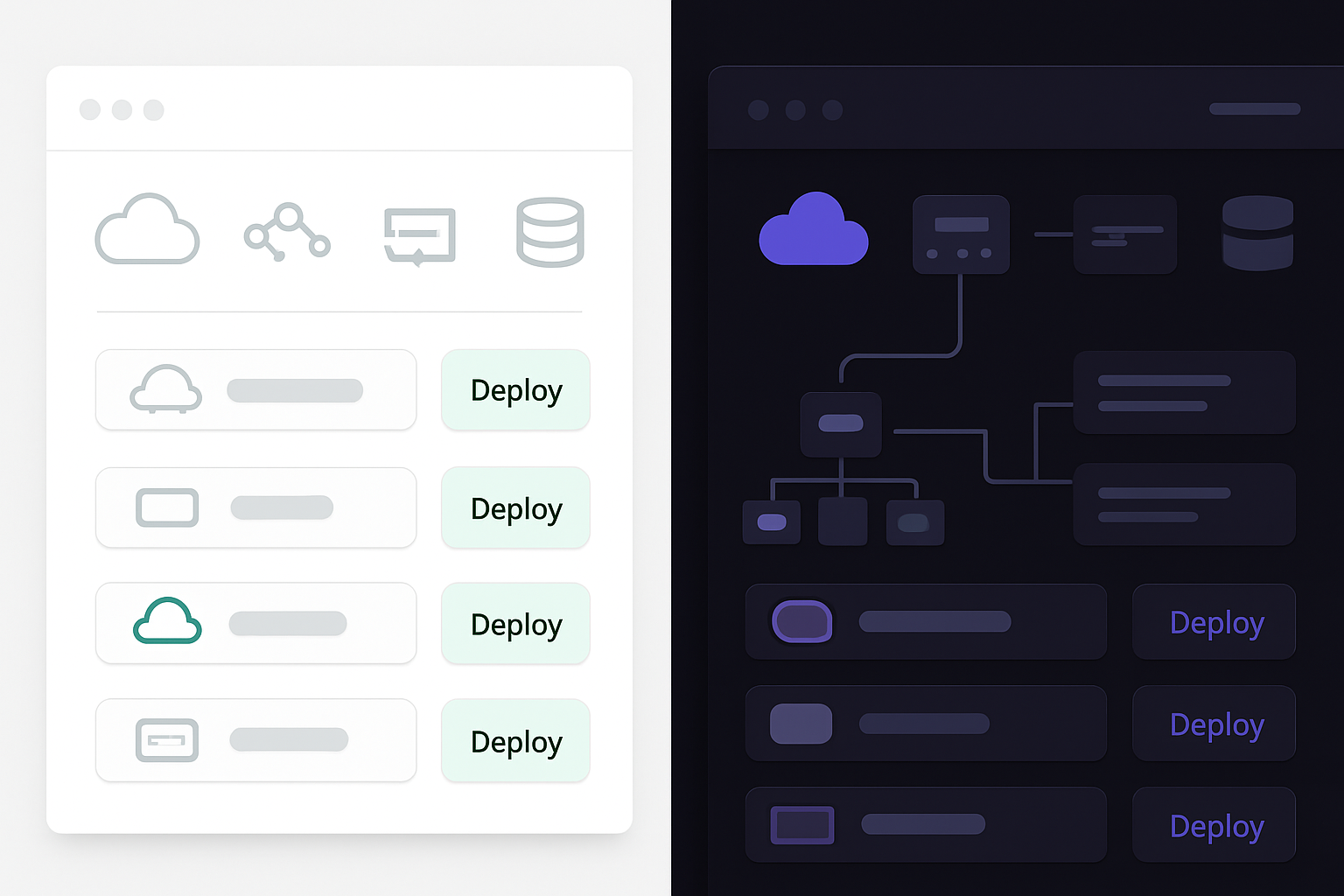
- The project canvas — a visual, real-time diagram of your services and their connections. Uniquely useful for multi-service apps.
- The CLI is tighter and more integrated with local development.
railway runinjecting your production env vars locally is a workflow improvement that’s hard to give up once you have it. - Template ecosystem — deploy Ghost, Plausible, PocketBase, Hasura, or dozens of other open-source services in one click. Render has templates, but Railway’s library is more comprehensive.
- Config as code via
railway.tomlfeels more natural and flexible than Render’s equivalent.
Render’s DX advantages:
- Simpler billing — you never wonder what the bill will be. For developers who find financial uncertainty stressful, this is not trivial.
- Static site hosting is best-in-class for a PaaS — free, fast, CDN-backed, with custom domains and automatic SSL.
- Preview environments are available on Render’s lower-cost plans and are mature. Railway offers them on Pro only.
- The UI is cleaner and less visually dense for projects with fewer services.
Reliability and Production-Readiness
Both platforms are production-capable. The distinction here is mostly about track record and perception rather than hard technical limits.
Render has been running longer, has more enterprises on its platform (including its Heroku migration program), and is generally perceived as the more conservative, reliable choice in developer communities. Its incident history, while not perfect, is considered solid.
Railway has improved substantially on reliability and uptime in 2024–2025. Its infrastructure is modern and its SLAs are competitive. However, developer community feedback still occasionally surfaces Railway incidents, particularly around database restores and storage edge cases.
For a solo developer’s side project or MVP, this distinction is minor — both platforms will serve you well. For a revenue-generating application with uptime SLAs to meet, Render’s track record provides slightly more confidence.
Database Support
Both platforms offer managed PostgreSQL. The key differences:
- Render: Managed Postgres with clear fixed-price tiers ($7 Starter, $20 Standard, $45 Standard Plus, etc.). Includes logical backups, point-in-time recovery on higher tiers, and expandable storage at $0.30/GB.
- Railway: Postgres deployed as a service, billed on the same usage-based model. Includes built-in backups on paid plans. Can also deploy MySQL, Redis, MongoDB as first-class services with similar simplicity.
Railway wins on breadth — its database support is more flexible and the usage model can make low-utilization databases cheap. Render wins on clarity — you know the Postgres cost upfront.
Ecosystem and Integrations
Neither platform has Heroku’s add-on marketplace depth. Both support custom environment variables for third-party services (Resend for email, Cloudinary for images, etc.), and both have a template/starter ecosystem.
Railway’s template library is more extensive. Render’s static site infrastructure makes it better for hybrid setups (frontend on CDN, backend on a web service). If you’re building a JAMstack-style app with a decoupled frontend, Render is the natural fit. If you’re deploying self-hosted open-source tools alongside your own app, Railway’s templates accelerate that.
The Verdict: Which One Should You Use?
Here’s the concrete recommendation by use case:
Choose Render if:
- You want predictable, fixed-cost billing.
- You’re hosting static sites (Render’s free tier is unmatched for this).
- You’re migrating from Heroku and want the most faithful experience.
- You prioritize reliability and a longer production track record.
- Your app is always-on and your traffic is relatively stable.
Choose Railway if:
- You have multiple services and want the project canvas to manage them visually.
- Your workloads are bursty, intermittent, or light — usage-based pricing will save you money.
- You use the CLI heavily and want tight local-to-production integration.
- You want to deploy open-source tools alongside your app from templates.
- You’re optimizing for the best DX and are comfortable monitoring consumption.
The honest answer for most solo developers: Try Railway for its DX and pricing efficiency. Keep Render in mind for static site hosting (it’s free) and as a fallback if Railway’s billing model creates anxiety. Many developers use both: Render for the static frontend, Railway for the backend and services.
Neither is a bad choice. Both are vastly better than the Heroku of 2024.
Get started on Render → [AFFILIATE LINK: Render]
Get started on Railway → [AFFILIATE LINK: Railway]