Fathom Analytics Review: Simple, Private, and Actually Enjoyable to Use
There is a category of tools that are technically good, but are also a genuine pleasure to use. Fathom Analytics sits in that category. Built by Jack Ellis and Paul Jarvis — two well-known figures in the indie internet space — Fathom has attracted a loyal following among founders, developers, and creators who want web analytics that respects both their visitors and their time.
This review covers Fathom Analytics in depth: what it does, what it costs, how it compares to Google Analytics 4, and whether it deserves a place on your stack.
What Is Fathom Analytics?
Fathom is a privacy-first web analytics tool. Like Plausible, it tracks visitors without cookies, without collecting personal data, and without requiring cookie consent banners. Unlike GA4, it doesn’t build advertising profiles of your visitors, doesn’t phone home to a US ad empire, and doesn’t require you to spend a weekend reading compliance documentation.
The company is proudly independent and has remained so since its founding. Fathom has built a strong reputation in the indie hacker and bootstrapper community — Joel Gascoigne (CEO of Buffer), Caleb Porzio (creator of Alpine.js), and many other high-profile builders have publicly endorsed it.
The product is hosted only — there is no self-hosted version. Fathom manages the infrastructure, which they describe as enterprise-grade, running on high-availability servers rather than cheap VPS instances. For the target market (site owners who want reliability without DevOps overhead), this is the right call.
Getting Started: The Fastest Setup in the Category
Setup with Fathom is genuinely fast. Create an account, add your site, copy a single line of JavaScript, paste it into your site’s <head>, and you’re collecting data. The entire process from signup to first pageview tracked can happen in under five minutes.
There is no data layer to configure, no event schema to define, no tag manager required. The script is lightweight and asynchronous — it won’t block your page load. Fathom also supports integrations with WordPress, Ghost, Webflow, Squarespace, Shopify, and most modern frameworks through community-maintained packages.
If you’re moving from GA4, the contrast is immediate. GA4 requires configuring “enhanced measurement,” setting up goals as conversion events, potentially configuring Google Tag Manager, and validating that your setup is working through a debug mode. Fathom just works.
The Dashboard Experience
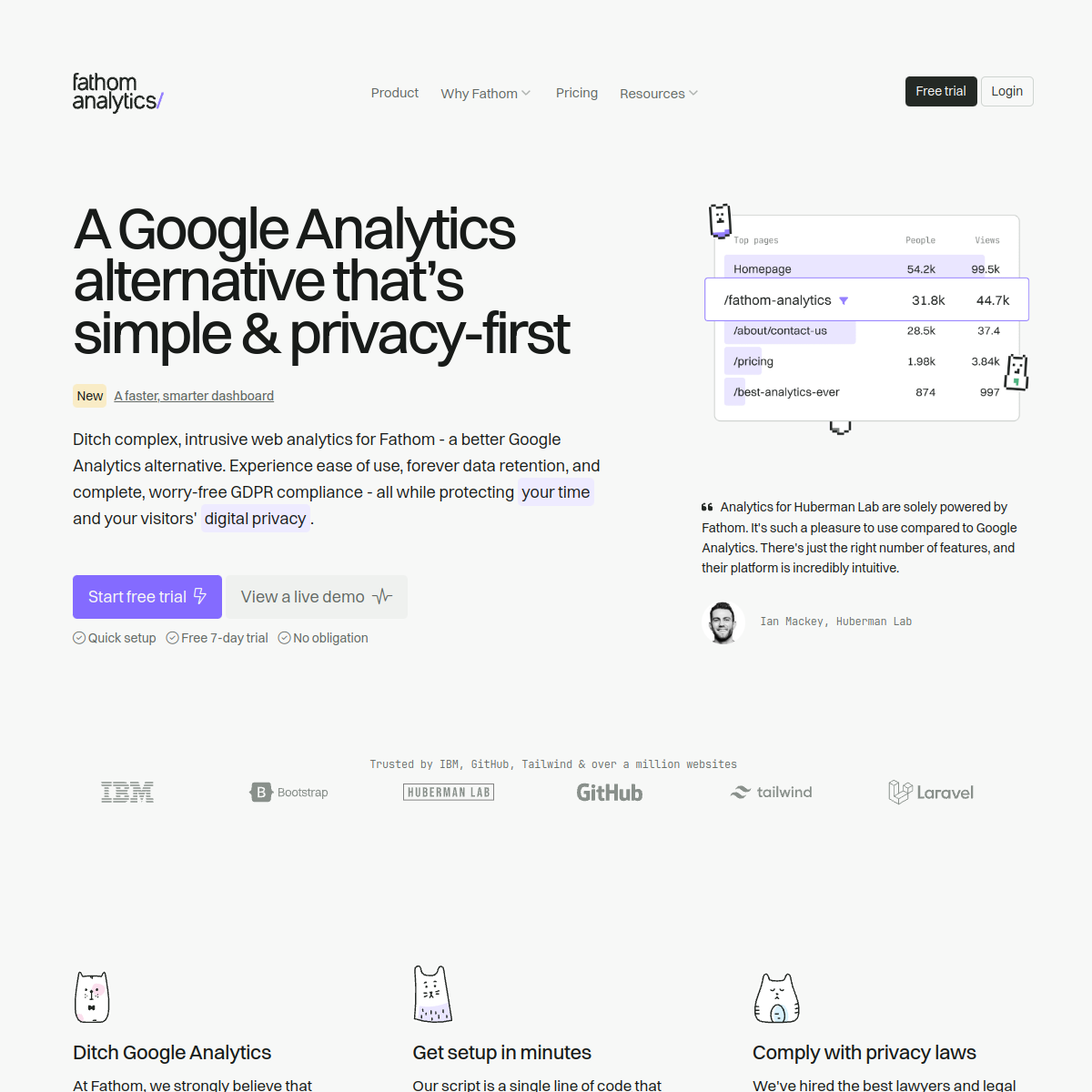
Fathom’s dashboard is clean, fast, and information-dense without being overwhelming. You get a real-time visitor count, a traffic graph (daily or hourly), and below that, breakdowns of top pages, referrer sources, countries, devices, and browsers.
What makes Fathom’s UI stand out is the attention to detail. The interface feels designed rather than assembled. Interactions are snappy. Filtering is intuitive — click any referrer, country, or page to filter the entire dashboard to that segment. The date picker includes presets (last 7 days, last 30 days, last year) plus a custom range.
Custom event tracking is available on all plans. You can track button clicks, form completions, video plays, and any other user action by adding a data attribute to your HTML or calling Fathom’s JS API. Goal conversions are tracked alongside traffic in the same dashboard view, which keeps reporting consolidated.
Fathom also supports uptime monitoring — a small but useful addition that means you’re alerted when your site goes down, without needing a separate tool. Email reports (daily, weekly, monthly) are included on all plans and are easy to set up and share with stakeholders.
Fathom vs Google Analytics 4: An Honest Comparison
GA4 is the incumbent, and for large enterprises or complex analytics needs, it is still dominant. Here is where the comparison actually stands:
- Ease of use: Fathom wins decisively. GA4’s interface is non-trivial for non-analysts. Fathom takes minutes to learn.
- Privacy and compliance: Fathom wins. No cookies, no consent banners, GDPR/CCPA/PECR compliant by default. GA4 requires explicit configuration and is subject to ongoing regulatory scrutiny in the EU.
- Data accuracy: Fathom likely wins for most sites. GA4 data is affected by cookie consent rates (users who decline are not tracked), adblocker blocking, and sampling on the free tier. Fathom’s script bypasses most blocklists.
- Depth of analytics: GA4 wins. If you need user-level paths, multi-touch attribution, audience segmentation, or Google Ads integration, GA4 is more capable.
- Cost: GA4 is free. Fathom starts at $15/month. That said, compliance infrastructure for GA4 is not free once you factor in consent management platform costs and developer time.
The realistic conclusion: for the vast majority of websites that don’t run paid acquisition campaigns at scale, Fathom gives you more actionable information with less friction and fewer compliance risks than GA4.
Pricing
Fathom’s pricing is simple and, notably, they never discount — ever. As of early 2026:
- 100,000 pageviews/month: $15/month
- 200,000 pageviews/month: $25/month
- 500,000 pageviews/month: $45/month
- 1,000,000 pageviews/month: $54/month
- 2,000,000 pageviews/month: $74/month
- 5,000,000 pageviews/month: $94/month
- 10,000,000 pageviews/month: $124/month
All plans include up to 50 sites, unlimited email reports, forever data retention, unlimited CSV exports, uptime monitoring, and custom event tracking. If you need more than 50 sites, Fathom charges approximately $14/month per additional block of 50.
Annual billing is available and provides the equivalent of two months free. A 30-day free trial is offered with no credit card required. Fathom’s stated philosophy is that the price you see today is the best price they will ever offer — no Black Friday sales, no promo codes. That transparency is unusual and appreciated.
Compared to Plausible, Fathom is slightly more expensive at entry level ($15/month vs $9/month for lower pageview tiers) but includes more sites and unlimited email reporting at every tier.
Privacy and Infrastructure: Built for the Long Haul
Fathom’s privacy architecture is cookieless by design. Nothing is stored in the browser. No IP addresses are logged. No fingerprinting. The company is Canadian-registered but operates under EU-friendly data principles. Data is stored on EU-based infrastructure where chosen, and the company has been vocal about its stance on data privacy long before it became a marketing talking point.
Their infrastructure claims are notable: Fathom says they run on enterprise-grade, high-availability servers — not commodity VPS instances — with global edge nodes for fast script delivery and processing. For sites with international audiences, this matters for both load performance and data reliability.
Who It’s For
Fathom Analytics is best suited for:
- Indie hackers and bootstrappers who want simple, honest data about their products
- Founders and content creators who want a beautiful, fast dashboard they’ll actually open
- Agencies managing multiple client sites — the 50-site limit at every tier is excellent value
- Privacy-conscious businesses that want GDPR compliance without the overhead
- Teams that appreciate good product design and want tools that don’t feel like chores
It is not a strong fit for teams running Google Ads at scale, businesses needing multi-touch attribution modelling, or large enterprises requiring complex user segmentation and BI integrations.
Verdict
Fathom Analytics is one of the most polished tools in the privacy-first analytics space. It is not the cheapest, and it is not the most feature-rich — but it is the one most likely to make you enjoy checking your analytics again. The setup is fast, the dashboard is a delight, and the privacy story is genuine rather than performative.
If you want analytics that respects your visitors, protects your compliance posture, and doesn’t make you feel like you need a data engineering certification to use, Fathom is a strong, confident choice.
Start your 30-day free trial with Fathom — no credit card needed. [AFFILIATE LINK: Fathom]