Plausible Analytics Review: The Best Google Analytics Alternative?
Google Analytics 4 is the most-installed analytics tool on the web. It is also, for a large slice of website owners, a complete overkill — a dense, event-driven platform that requires setup time, cookie consent infrastructure, and a tolerance for dashboards that look like mission control. For bloggers, indie developers, small SaaS teams, and anyone who just wants to know “how many people visited my site and where did they come from,” GA4 is arguably too much.
Plausible Analytics sits at the opposite end of that spectrum. Built by a small team in Europe and launched in 2019, Plausible is a lightweight, privacy-first web analytics tool that fits on a single dashboard, requires no cookie banner, and processes no personal data. This review covers what it does well, where it falls short, and whether it can genuinely replace Google Analytics for your use case.
What Is Plausible Analytics?
Plausible is a hosted web analytics platform built specifically to be a privacy-respecting alternative to Google Analytics. It is open source, which means you can self-host it if you have the infrastructure — but most users pay for the cloud-hosted version and let Plausible manage the servers.
The tracking script is tiny: under 1KB, compared to the 45KB+ script Google Analytics loads on your site. It collects aggregated data only — no cookies, no fingerprinting, no cross-site tracking. Every metric is anonymised at the point of collection. This makes Plausible automatically compliant with GDPR, CCPA, PECR, and similar regulations, without requiring you to configure anything or show a cookie consent banner to your visitors.
That last point is underrated. Cookie banners are friction. Visitors dismiss them, block them, or quietly distrust the site that shows one. Plausible eliminates the requirement entirely.
The Dashboard: What You See and What You Don’t
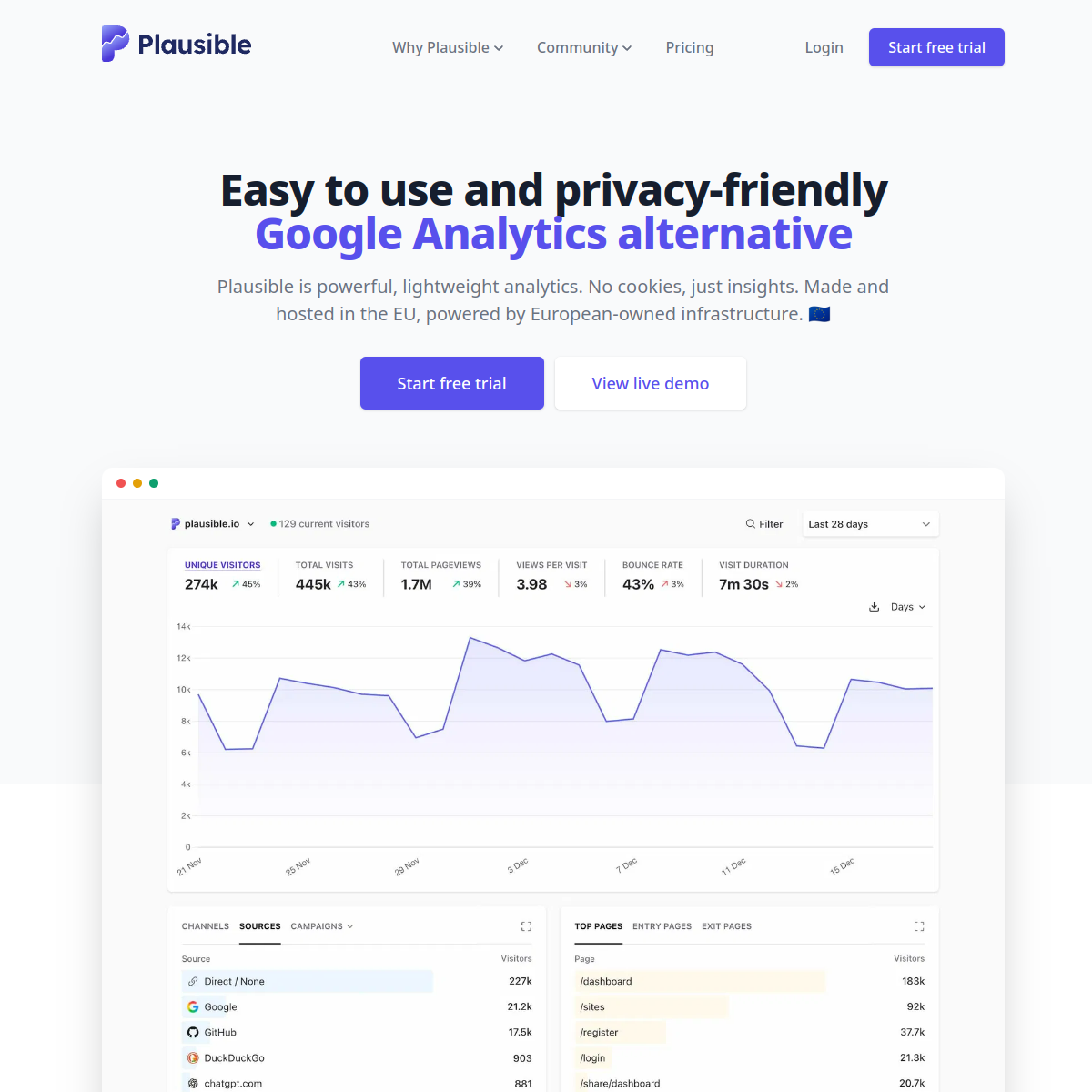
Log into Plausible and you land on one scrollable page. At the top: total unique visitors, total pageviews, bounce rate, and visit duration for whatever time window you’ve selected. Below that: top sources, top pages, countries, devices, and browsers — all in a clean, minimal layout that loads almost instantly.
There are no sub-menus, no reports to configure, no “exploration” tabs, and no stream-of-events interface. What you see is what you get. For most site owners, this is liberating. For teams that need conversion funnels, user-level behaviour analysis, or product analytics depth, it will feel limited.
Goal tracking and custom events are available on higher plans. You can set up conversion goals based on pageviews or custom events, track outbound link clicks, file downloads, and form submissions. Business plan users also get funnel analysis, custom properties, and e-commerce revenue attribution. These features are genuinely useful — but they are deliberately narrower in scope than what GA4 offers.
Plausible vs Google Analytics 4: The Real Comparison
GA4’s power comes at a cost. To use it properly you need to:
- Configure events manually (pageviews are not automatically tracked the way UA used to handle them)
- Display a cookie consent banner in most jurisdictions
- Accept that some traffic will be blocked by browsers or ad blockers (GA4 scripts are routinely blocked)
- Learn a new reporting interface that is genuinely unintuitive for non-analysts
Plausible sidesteps all of this. The script is not on any blocklist. There are no cookies to consent to. The interface requires no training. If you want to know your traffic trends, top content, and acquisition sources, Plausible gives you that in under ten seconds after logging in.
Where GA4 wins: session-level analysis, user journey mapping, advanced audience segmentation, integration with Google Ads, BigQuery export, and the sheer depth of what you can explore. If you run paid campaigns, rely on attribution modelling, or need to share data with a BI tool, GA4’s capabilities are genuinely useful.
For the overwhelming majority of content sites, small SaaS products, and personal projects, Plausible’s data is richer in practical insight-per-minute than GA4 — simply because you can actually read it.
Pricing: What It Costs
Plausible operates on a pageview-based pricing model with multiple feature tiers. As of early 2026, the plans are structured as follows:
- Starter: From $9/month for up to 10,000 pageviews. Includes 1 website, 3 team members, goals, custom events, email/Slack reports, and 3 years of data retention.
- Growth: From $14/month. Adds up to 3 sites, shared links, and embedded dashboards.
- Business: From $19/month for 100,000 pageviews. Up to 10 sites, 10 team members, 5-year data retention, funnels, custom properties, e-commerce revenue tracking, Stats API, and Looker Studio connector.
- Higher tiers scale: 200K pageviews at $29/month, 500K at $49/month, 1M at $69/month, 2M at $89/month.
- Enterprise: Custom pricing for 10M+ pageviews or large teams.
Annual billing is available and saves roughly two months’ cost per year. A 30-day free trial requires no credit card. Compared to hiring a consultant to manage GA4 cookie compliance or spending hours configuring a GDPR-compliant data layer, even the mid-tier Plausible plans are extremely cost-effective.
Google Analytics 4 is free for standard use — that is worth acknowledging. If budget is the primary constraint and you have the technical tolerance for GA4’s complexity, you can make it work for nothing. Plausible’s value is in time saved, compliance peace of mind, and data you can actually act on.
Privacy, Compliance, and Why It Matters for Your Visitors
Plausible is incorporated in the EU and processes all data on EU-owned infrastructure. It does not use cookies, does not collect IP addresses, does not use device fingerprinting, and does not share data with third parties. There is nothing to configure to be GDPR-compliant — the architecture is compliant by design.
This is meaningfully different from GA4, where achieving GDPR compliance requires configuring consent mode, setting up cookie banners, potentially anonymising IPs, and potentially dealing with data transfer concerns since US-based companies’ tools are still under regulatory scrutiny in some EU member states.
For European businesses, media publishers, or anyone who has been burned by a privacy notice before, Plausible genuinely removes a layer of legal risk.
Who It’s For
Plausible is an excellent fit for:
- Content creators and bloggers who want to know what’s working without a data science degree
- Indie hackers and solo founders building products and tired of GA4’s complexity
- Small SaaS teams who need product metrics without a dedicated analytics engineer
- EU-based businesses under GDPR pressure who want compliance by default
- Agencies who want to give clients a clean, white-labeled analytics view
It is not a great fit for businesses running heavy paid acquisition campaigns that rely on GA4-to-Google Ads attribution, or for product teams that need session replays, cohort analysis, and deep funnel exploration.
Verdict
Plausible Analytics earns its reputation as the most credible Google Analytics alternative for straightforward web analytics. The data it surfaces is honest, fast, and actionable. The privacy story is genuinely strong — not just marketing. The pricing is fair for what you get.
If you have ever found yourself logging into Google Analytics, staring at the interface, and leaving without learning anything useful, Plausible will feel like a breath of fresh air. It does less on purpose — and for most use cases, “less” is exactly right.
Try Plausible free for 30 days — no credit card required. [AFFILIATE LINK: Plausible]